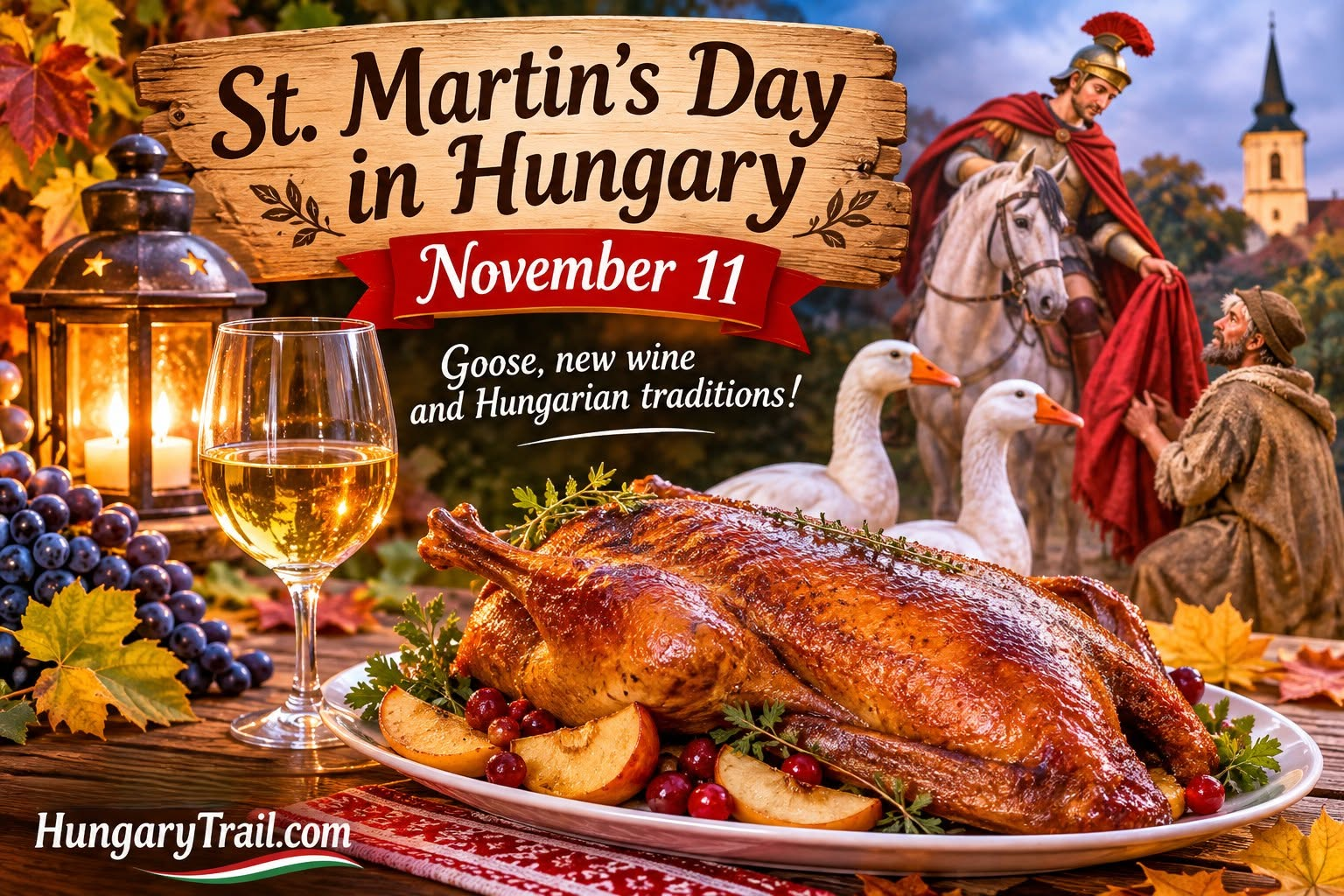
While the world gets ready for winter, Hungary celebrates. Every year around 11 November the smell of crackling goose skin drifts through the restaurants, cellars open their doors for a first taste of the year's new wine, and children march down the dark streets with glowing paper lanterns. This is St. Martin's Day — one of the least known, yet most beautiful, dates on the Hungarian calendar for visitors from abroad.
And the best part: the saint the feast is named after was born in Hungary.
St. Martin's Day 2026 at a glance
- Date: Wednesday, 11 November 2026 (most events take place on the weekends of 6–8 and 13–15 November)
- Symbols: goose, new wine, lantern
- The dish to order: goose leg with braised red cabbage, goose liver, goose cracklings, bread spread with goose fat
- The drink to order: new wine, the first wine of the year
- A public holiday? No — but restaurants and wine regions go all out, so it is worth booking ahead
- Who is it for? Food and wine lovers, families, and anyone looking for a real local tradition
Who was Saint Martin, and why is he Hungarian?
Saint Martin of Tours was born around 316 in Savaria, today's Szombathely, then a city of the Roman province of Pannonia. He grew up in northern Italy, joined the army as a young man, and became one of the most beloved saints of medieval Europe.
His best-known story takes place on a cold winter evening at the city gate of Amiens, in France. The young soldier Martin met a shivering beggar. Having nothing else to give, he cut his military cloak in two with his sword and gave one half to the beggar. Legend says that same night he saw Christ in a dream, wearing the half-cloak. The scene has been painted, carved and told for 1,700 years, and that is why Martin became a symbol of kindness and sharing.
Martin later became bishop of Tours and died in 397. The day of his funeral, 11 November, became his feast. Szombathely still proudly calls itself his birthplace, and the Archabbey of Pannonhalma stands on the hill also known as St. Martin's Hill.
Why the goose? The legend that landed on the table
The star of the feast is the goose, and there is a charming explanation. When the people of Tours wanted to make the modest Martin their bishop, he felt unworthy and hid in a goose pen. The geese gave him away with loud honking — so Martin became bishop, and the geese, the legend says, have ended up on the table every November in revenge.
There are practical reasons too. In the old farming calendar, St. Martin's Day was the end of the agricultural year: the harvest was in, the geese were fat, servants and shepherds were paid, and the cold season began. A great feast was the most natural way to close a year's work.
A Hungarian saying sums it up: "Whoever does not eat goose on St. Martin's Day will go hungry all year."
You have been warned!
What should we eat and drink on St. Martin's Day?
The goose
In Hungary the goose is held in high regard. Expect a juicy goose leg with crackling skin, usually served with braised red cabbage and a potato side — potato dumplings, potato pancakes or roast potatoes. Many restaurants offer a full St. Martin's menu: goose liver, goose soup, roast goose and a dessert such as pancakes or apple cake.
Hungary is one of the world's notable producers of foie gras, so festive menus often include goose-liver pâté or pan-fried goose liver as well.
Simple countryside favourites
At village festivals and fairs, look for goose cracklings — a crisp, salty bite that is perfect with a glass of wine — and bread spread with goose fat, purple onion and paprika. Both are classics of the Hungarian country kitchen.
The new wine
An old saying has it that on St. Martin's Day "the must becomes wine". Tradition holds that 11 November is the moment when the year's first wine may be tasted and blessed, and cellars across the country open their doors. New wine is young, fruity, fresh and slightly cloudy, and it pairs beautifully with the rich flavours of goose. Many St. Martin's programmes include a cellar crawl, wandering from one winery to the next and tasting as you go.
Sweet St. Martin's bites
Children's programmes often bake St. Martin's crescents and decorate goose-shaped biscuits, so if you are travelling with children, look for the family workshops.
Old customs and folk beliefs
St. Martin's Day is full of old traditions, many of which still live on in smaller communities:
- The end of the farming year: fieldwork was over, and villages held feasts, fairs and balls.
- Weather lore: Martin's Day was traditionally used to forecast the winter. A well-known saying says that if Martin arrives on a white horse, the snow comes early.
- Shepherds' rounds: in some villages with Swabian roots the custom still lives that shepherds go from house to house, wish health and plenty, and receive a gift in return.
- Goose games: villages offer children a goose-feather hunt, goose skill games, and even a goose race.
The lantern procession: the most magical part of the feast
If you arrive in the evening, you may see something you will not forget: dozens of children and parents walking in the dark with glowing paper lanterns, often singing Martin's songs. The lantern procession stands for light in the darkest part of the year, and it recalls Martin's kindness.
Most of these programmes begin in the afternoon with lantern-making, followed by a story or a folk performance, and finally the procession. At the end there is usually hot tea, mulled wine, roasted chestnuts and bread with goose fat waiting. Simple, friendly and atmospheric — and visitors are always welcome.
Practical tips for the events
- Book early. The best goose menus in Budapest sell out, especially on the weekends around 11 November.
- Plan for the weekend. Because 11 November falls on a Wednesday, the biggest events are between 6–8 and 13–15 November.
- Expect to pay more than for an ordinary lunch: in Budapest restaurants a three-course St. Martin's menu with a glass of new wine is typically a set price (last year's example: about 11,900 Ft).
- Dress warmly. Lantern processions and village events take place outdoors, and November evenings are chilly.
- Taste the new wine, but in moderation. New wine is lighter than aged wines, but it is still wine.
- Carry cash for the smaller village fairs and food stalls.
- Travelling with children? Look for "family programme" and "lantern-making" — these are the best events for little ones.
Did you know?
- Saint Martin is also known as the patron of soldiers, beggars and winemakers.
- Germany's Martinsgans, Austria's Martinigansl and France's feast of Saint-Martin keep similar traditions — roast goose and new wine are tied to Martin's Day across much of Central Europe.
- The lantern procession is the highlight of the St. Martin's programme in most Hungarian kindergartens and schools.
Why you should not miss it
St. Martin's Day is not a tourist attraction. It is a living tradition that families, winemakers and villages celebrate together at the end of the harvest year. It is the perfect reason to travel to Hungary in the quiet, atmospheric weeks of November: warm cellars, golden vineyards, crackling goose, and a lantern in your hand.
Come hungry. Come curious. Bring a lantern. A programme guide will appear soon on this website and on the HungaryTrail Facebook page.